Commercial High Rise Window Cleaning Contract Bid Math

Meric Karpat · Founder & CEO
A two-person window cleaning crew in Denver has cleaned storefronts and one-story office lobbies for four years. A property manager emails asking for a monthly exterior bid on a 14-story Class B office tower. The chief prints the bid on the same $1.25 per pane rate he charges a dentist office and submits it the next morning. He wins. He also loses roughly $1,900 in the first three months because he never priced in the rope-access gear, the extra insurance endorsement, or the weather days that push a one-day job into two.
commercial high rise window cleaning contract bids fail the same way every time: the operator brings storefront math to a tower job. The contract is where you either lock in a price that covers your real cost stack or you sign away your margin for a year. This is the framework a crew needs before the first tower bid goes out, built from what actually costs money above 40 feet.
Here is how to price the job, what the contract has to carry, and the six numbers that separate a profitable recurring account from a loss you discover at month four.
What Belongs in a Commercial High Rise Window Cleaning Contract Bid
The bid is not a pane count. It is a cost stack plus a margin, and the contract is the document that protects the margin. The stack for a tower has five layers a storefront bid does not: access method and rigging, insurance that names the building as additional insured, weather contingency, mobilization, and a quality standard the property manager can hold you to.
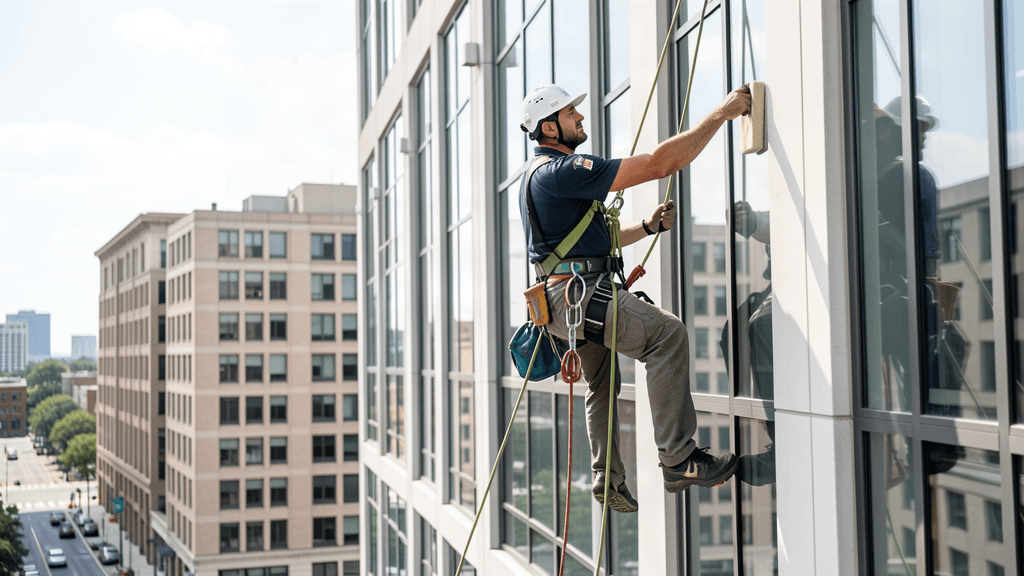
Start with access. How the crew reaches the glass drives everything else. Ground-runged ladders cap out around 30 feet for most commercial work. Boom lifts work to about 80 feet but need a certified operator and a clear set-down area. Above that you are in rope access, suspended scaffolding, or a building roof-rig system the owner already has. Each method changes your labor cost, your insurance requirement, and your mobilization time. A rope-access job can take half a day to rig and inspect before a single pane gets touched. A storefront crew that bids the tower at storefront rates just donated that half day.
The Real Cost Stack Above 40 Feet
Most crews underbid towers because they price labor only and forget the four costs that only appear at height. Add these to the bid, or eat them.
1. Rope-access or high-work certification. OSHA treats window cleaning above 30 feet as a regulated access job. A certified rope-access technician (the SPRAT or IRATA track is the recognized standard) costs the crew roughly $1,200 to $2,800 per person to certify and recertify every three years, plus a week of unpaid training time. If the building requires documented certification and you bid an uncertified crew, you either lose the bid on verification or win it and carry the liability of an untrained worker on a rope.
2. General liability with a high-work endorsement. A standard $1 million GL policy for a storefront cleaner runs $600 to $1,200 a year. The same policy with a high-work endorsement, naming the tower owner as additional insured and covering work above two stories, typically runs $2,400 to $5,000 a year and requires a separate application documenting your access methods and training. The Building Owners and Managers Association notes that most commercial leases push window-cleaning liability onto the vendor, so a policy without the endorsement leaves the crew personally exposed on a $40,000 dropped-object claim.
3. Mobilization and rigging. Getting gear to the roof, inspecting anchors, and setting up descent systems is labor that does not touch glass. Budget 2 to 4 crew-hours of rigging per drop for a first-time building. Repeat visits on a monthly contract drop to roughly 45 minutes once the rig plan is documented.
4. Weather contingency. Wind above 25 mph or visible precipitation shuts down rope and lift work per OSHA guidance. A one-day bid on a 14-story exterior commonly takes two calendar days when you build in the realistic chance of a wind hold. If you bid one day and the contract does not carry a weather clause, the second day comes out of your margin.
How to Price: Per Drop, Per Pane, or Per Square Foot
Three pricing structures show up in commercial bids, and each one protects you differently.
Per-drop pricing
You charge a fixed amount per descent line or per scaffolding drop, regardless of how many panes it covers. This is the safest structure for the operator because rigging time is the same whether the drop covers 8 panes or 14. A 14-story tower typically breaks into 4 to 8 drops depending on facade width. Pricing $350 to $600 per drop for a first-time monthly exterior, with rigging baked in, holds margin when the building hands you a wide drop with few panes.
Per-pane pricing
This is what the storefront crew tried to bring to the tower. It works at street level where access is a ladder and mobilization is ten minutes. On a tower it under-recovers on rigging-heavy drops and over-recovers on glass-heavy drops. Use it only as a tiebreaker inside a per-drop framework, never as the headline number.
Per-square-foot of facade
Property managers like this because it is easy to compare across bidders. The published benchmark for exterior high-rise glass runs $0.18 to $0.45 per square foot of facade depending on access difficulty and frequency, with monthly contracts landing lower per visit than quarterly because mobilization amortizes. Anchor your square-foot number to your per-drop cost so a low-bid competitor cannot drag you under your rigging floor.
Contract Clauses That Protect the Margin
The contract is where a profitable bid stays profitable across a 12-month term. Three clauses do the heavy lifting.
Weather and access delays. The clause should state that work is scheduled subject to OSHA wind and precipitation limits, that a weather hold does not constitute a missed service for penalty purposes, and that a rescheduled visit occurs within a defined window (typically 5 business days). Without it, a property manager can charge back a missed-visit penalty for a day you were legally barred from working.
Additional insured and certificate delivery. The contract must require you to deliver a certificate of insurance naming the owner and property manager as additional insured, with the high-work endorsement listed by name. Deliver the certificate before mobilization, not after. A tower owner who lets an uncertified, uninsured crew on the roof is carrying your risk.
Scope and quality standard. Define what "clean" means and how it is verified: inspection from the interior at a set viewing distance, re-clean of any flagged pane within 48 hours, and a defined tolerance for hard-water and mineral staining that pre-existing glass may carry. The single most common scope-creep source on tower work is a tenant complaint about spotting on glass that was already etched before you arrived. The clause turns that into a documented condition, not a free re-clean.
Monthly vs Quarterly: Which Recurring Structure Pays
The bid has a frequency decision baked in, and it changes the economics more than the per-visit price does. A monthly exterior contract on a 14-story tower amortizes your rigging and insurance across 12 visits. A quarterly contract amortizes across 4, so each visit has to carry three times the fixed-cost recovery per drop.
Run the per-visit cost both ways before you submit. If monthly lands at $2,800 a visit and quarterly at $4,200 a visit, the quarterly still has to recover the same annual insurance and certification cost in a third of the visits. Most crews discover too late that the quarterly number that looked competitive per visit was below their fixed-cost floor for the year. Property managers will often accept a monthly price that is lower per visit than quarterly if the crew can show the building gets cleaner glass for less annual spend, which it usually does.
What Can Go Wrong and What the Contract Cannot Fix
Some risks live outside the contract. A roof anchor that fails inspection mid-contract means you cannot legally descend that facade until the owner repairs it, and no clause makes the owner pay you for the lost visit. Build an anchor-condition walkthrough into the bid visit before you quote, and document the anchor certification date. If the anchors are out of certification, the bid is for ground-access or lift work only, and the price changes.
The same applies to tenant access. Interior glass work on a tower means coordinating with 40-plus tenants on scheduling, and a crew that does not price that coordination time into the bid loses a full day chasing keys and access fobs. Price interior coordination as a separate line item so the building sees it as a real cost, not a free favor.
Next Steps and the 6-Month Revisit
After the first tower contract runs three months, pull the actuals against the bid. Compare real rigging hours, weather holds, insurance cost amortized per visit, and any re-clean callbacks against the numbers you quoted. The first tower is almost always underbid somewhere; the fix is the contract renewal, not a mid-term price increase the building will resist.
Revisit the cost stack at the 6-month mark and at renewal. Insurance premiums and certification costs move year over year, and a contract that auto-renews at year-one pricing is how a profitable account quietly turns into a break-even one. Document the real cost per drop in a spreadsheet the crew keeps, and bring the updated number into the renewal conversation before the building shops the bid out again. A crew that knows its real per-drop cost can defend a renewal increase with numbers a property manager can verify, which is how a one-bid tower account becomes a five-year recurring revenue line.
This guide is published by Heyfield, which makes an AI phone receptionist for home-service trade businesses. If you ever can't take the call, that's what we do. See pricing. The rest of our trade-business resources are free at heyfield.app/blog.
Frequently Asked Questions
What does rope-access certification cost for window cleaning?+
A SPRAT or IRATA rope-access certification runs roughly $1,200 to $2,800 per person to certify and recertify every three years, plus about a week of unpaid training time. Buildings above 30 feet typically require documented certification under OSHA access rules.
How much is general liability insurance for high-rise window cleaning?+
A standard $1 million GL policy for a storefront cleaner costs $600 to $1,200 a year. Adding a high-work endorsement that covers work above two stories and names the tower owner as additional insured usually raises that to $2,400 to $5,000 a year.
Should I price commercial window cleaning per drop or per pane?+
Per-drop pricing is safer on towers because rigging time is the same whether a drop covers 8 panes or 14. Per-pane works at street level but under-recovers on rigging-heavy drops. Use per-pane only as a tiebreaker inside a per-drop framework.
What is the going rate per square foot for high-rise window cleaning?+
Exterior high-rise glass typically runs $0.18 to $0.45 per square foot of facade, depending on access difficulty and frequency. Monthly contracts land lower per visit than quarterly because mobilization and rigging amortize across more visits.
What clauses must a commercial window cleaning contract carry?+
Three matter most: a weather and access-delay clause tied to OSHA wind and precipitation limits, an additional-insured certificate delivery requirement, and a defined scope and quality standard that covers hard-water and mineral staining on pre-existing glass.
Is a monthly or quarterly window cleaning contract more profitable?+
Monthly usually wins because it amortizes fixed rigging and insurance costs across 12 visits instead of 4. A quarterly visit has to recover three times the fixed cost per drop, which is where crews quietly bid below their annual cost floor.
What happens if a building's roof anchors fail inspection mid-contract?+
You cannot legally descend that facade until the owner repairs the anchors, and the contract cannot force the owner to pay you for the lost visit. Walk the anchor condition and certification date before you bid, and price ground-access or lift work separately if anchors are out of certification.
How often should I revisit my tower window cleaning pricing?+
Pull actuals against the bid at three months and revisit the full cost stack at the six-month mark and at renewal. Insurance premiums and certification costs move year over year, and an auto-renew at year-one pricing is how a profitable account turns break-even.
Ready to stop missing calls?
Try Heyfield free for 7 days. Your AI receptionist answers every call, collects customer details, and texts you the summary.
Keep Reading
Locksmiths: Your Most Valuable Calls Come After Midnight
Locksmiths lose $3,000+ every month to missed after-hours calls. Here's what that's costing you — and the simple fix.
ReadDeck Builders: Stop Losing $90K Every Spring
Deck builders miss 2-3 quote calls a week during peak season. Here's the real revenue cost—and how to fix it without hiring a receptionist.
Read