Pressure Washing Pricing Per Square Foot by Surface Type

Meric Karpat · Founder & CEO
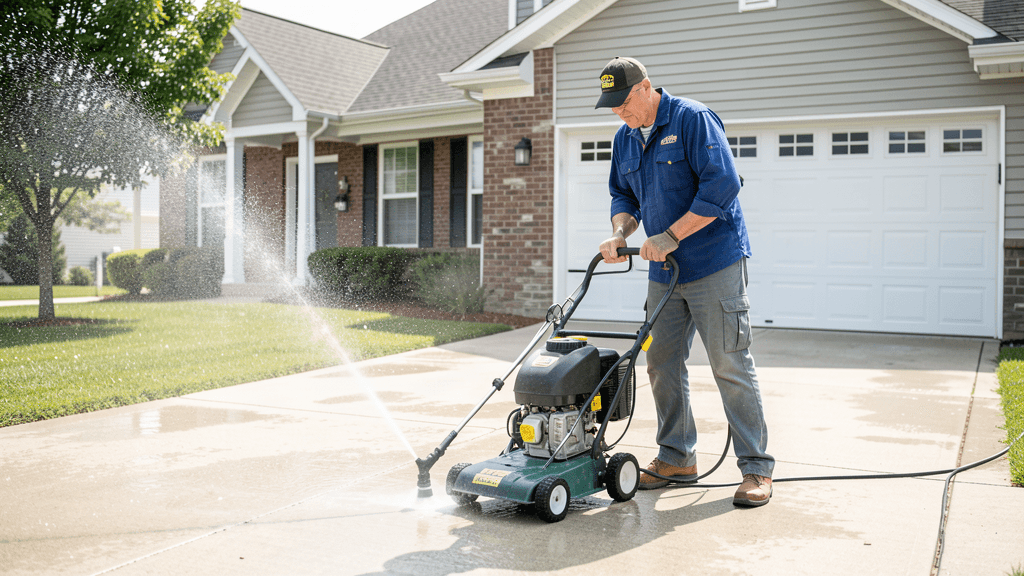
A two-person pressure wash crew in suburban Atlanta gets a Monday text asking for a whole-property quote: a 1,800-square-foot concrete driveway, a 320-square-foot wood deck, 2,100 square feet of vinyl siding, and a roof the owner wants "soft washed." The owner has been charging a flat $250 per house all season. He finished July with $11,400 in revenue and a tank of sodium hypochlorite, two cases of downstream injectors, and a fuel card balance that ate most of what was left.
Pressure washing pricing per square foot is the only way that quote stops bleeding margin. A flat $250 covers a 1,200-square-foot ranch driveway and a 3,500-square-foot two-story on a steep lot at the same number, and the second job costs you twice the chemical and three times the labor. Per-square-foot pricing forces the job to carry its own cost stack instead of subsidizing the last one.
Here is a working framework for setting your own rates by surface, built around the four numbers that actually move your margin: production rate, chemical cost, water and reclaim cost, and the equipment hours you burn per thousand square feet.
Pressure washing pricing per square foot starts with your production rate
Production rate is the square feet your crew can clean per hour on a given surface with your exact machine, and it is the number every published cost calculator skips. A 4-gallon-per-minute pressure washer running a 24-inch belt-driven surface cleaner on flat, unsealed concrete typically lays down 8,000 to 10,000 square feet per hour under good conditions, per manufacturer surface-cleaner specs and published contractor production benchmarks. The same machine on a wood deck, working board by board with a 40-degree tip to avoid furring the grain, drops to roughly 1,200 to 1,800 square feet per hour. Vinyl siding cleaned by downstream injection runs about 2,000 to 2,500 square feet per hour. Roof soft-washing, done from the ground or a low-pitch walk, covers 1,000 to 1,500 square feet per hour because the dwell time, not the rinse, is the bottleneck.
Write your production rate on a card and tape it to the truck. When a homeowner asks for a same-day number, you multiply rate by your per-square-foot price and give a real answer instead of a guess that turns into a loss.
Per-surface rates: driveways, decks, siding, and roofs
Each surface carries its own chemical, dwell, and risk profile. Charging one blended rate flattens the hard jobs and inflates the easy ones. Use a tiered sheet and let the surface set the band.
Concrete and paver driveways
Concrete is the fastest, highest-volume surface you clean. Residential driveways run $0.15 to $0.25 per square foot in most metro markets; sealed or stained concrete that needs a degreaser pre-treat for oil pushes toward $0.30. At a 9,000-square-foot-per-hour production rate and a two-person crew billing $0.20, you gross $1,800 an hour on machine time, before chemical. Paver driveways with sand joints add a re-sanding line item, $0.05 to $0.10 per square foot, because high pressure blows the polymeric sand out and the homeowner will call you back when weeds return.
Wood decks
Decks are the surface most often underpriced. Board-by-board work at 1,500 square feet per hour means a 320-square-foot deck is 13 minutes of spray time and 40 minutes of setup, chemical application, dwell, and a gentle rinse that does not fur the wood. Residential decks run $0.50 to $0.85 per square foot; a deck older than ten years with gray oxidation or a failing stain layer adds a stripper step and pushes you toward $1.00. Quote the deck separately from the driveway always, because the production rate is a fifth of concrete and the callbacks (furred grain, splintering) cost you a return trip.
Vinyl and stucco siding
Siding is a chemical job more than a pressure job. A sodium hypochlorite house wash through a downstream injector at 0.5 to 1 percent kills the mildew and runs $0.20 to $0.35 per square foot of wall area. Stucco costs more, $0.40 to $0.60, because you work at low pressure to avoid driving water behind the cladding, and a blown stucco callback is a moisture-intrusion claim, not a free rewash. Measure wall area net of windows and doors, or you overprice by 15 percent and lose the bid.
Asphalt shingle roofs (soft wash only)
Roofs are the highest-margin, highest-risk surface. Never pressure wash an asphalt shingle roof; you strip the granules and void the manufacturer warranty. Soft wash with a roof mix at 1 to 3 percent sodium hypochlorite, applied low-pressure, runs $0.30 to $0.50 per square foot. A 2,000-square-foot roof at $0.40 grosses $800 in roughly 90 minutes of active work, but the chemical cost alone can hit $60 to $90, and the liability is steep. Carry a roof-specific rider on your general liability policy, or do not bid the roof at all.
Chemical cost per gallon and why it breaks flat-rate quotes
Sodium hypochlorite is the single largest variable cost on a house or roof wash, and it is the reason a flat $250 house wash loses money by August. A working house-wash mix of 1 percent chlorine delivered through a downstream injector pulls roughly 10 gallons of finished mix per 1,000 square feet of wall. Bulk 12.5 percent chlorine runs $3 to $5 per gallon at the supply house in 2026, so the raw chlorine in a 2,100-square-foot house wash costs $6 to $11 before you count the surfactant that lets it cling. On a roof, a 3 percent mix over 2,000 square feet can consume 15 to 20 gallons of raw chlorine, $45 to $100 in chemical alone.
If you quoted that roof at a flat $250, the chemical and the fuel to drive 40 minutes round trip leave you under $120 for two hours of skilled labor and a chunk of equipment depreciation. Track chlorine price per gallon on your rate sheet and re-price every 60 days, because supply-house chlorine moved roughly 20 percent in a single quarter in recent years and a stale rate sheet silently erodes the whole season.
Water volume, reclaim, and the runoff compliance line item
A 4-GPM washer pushes 240 gallons an hour; an 8-GPM machine pushes 480. On a property with no hose spigot within 200 feet, you carry a buffer tank and the fill time eats your production rate. Water is cheap as a raw input, but reclaim is not. Under the federal Clean Water Act and the EPA Stormwater Multi-Sector Permit framework, wash water carrying chlorine, oil, and sediment cannot discharge into a storm drain untreated. In metro markets with active enforcement, a driveway job on a property that drains to the street can require a surface mat, a vacuum boom, and a holding tank to capture and either treat or dispose of the runoff.
Build a reclaim line item into your per-square-foot rate where it applies, $0.03 to $0.08 per square foot, or quote it as a separate $75 to $150 flat charge for the containment setup. The operator who ignores this is one inspector away from a four-figure fine that erases a month of driveways.
Equipment depreciation and the minimum job charge
A commercial belt-drive washer runs $4,000 to $9,000, a surface cleaner $400 to $900, injectors and hoses another $600, and a used enclosed trailer $6,000 to $12,000. Spread that $12,000 to $22,000 across a 1,200-billable-hour season and your equipment depreciation is $10 to $18 per billable hour before the first gallon of fuel. A job under $125 rarely covers the truck roll, the equipment hour, and the chemical for a one-person crew, which is why every rate sheet needs a minimum job charge. Most two-person crews set a $150 to $200 floor: below that number, the drive time and setup eat the margin, and you are better off filling the slot with a production-rate job.
The minimum charge is also your defense against the small-job churn that fills a calendar without filling a bank account. Quote the floor plainly. The customer who walks over a $150 minimum was never going to pay the per-square-foot rate that keeps you solvent.
When to quote per square foot versus a flat rate per job
Per-square-foot pricing wins on any surface where production rate is predictable and the square footage is measurable before you bid: driveways, flat sidewalks, siding, roofs. Flat-rate-per-job pricing wins on three cases. First, recurring commercial accounts, a restaurant dumpster pad or a gas station canopy on a monthly contract, where you charge $150 to $300 per stop regardless of square footage because the route density, not the area, is the value. Second, small bundled residential jobs under your minimum where measuring and quoting per square foot costs more in office time than the job earns. Third, post-construction cleanup, where the unknown, the dried mortar, the paint overspray, the stucco droppings, makes a per-square-foot guess a liability, so you bid a flat $400 to $900 with a written scope and a change-order clause.
The discipline is to know which case you are in before you send the number. A per-square-foot quote on a post-construction job where the surface condition is unknown is how a $600 bid becomes a $1,200 cost and a one-star review.
A six-month pricing review for chemical and fuel swings
Set the rate sheet on January 1 and walk it again on July 1. In that review, pull three numbers: chlorine cost per gallon at your supply house, diesel or gas per gallon, and your actual production rate from the last 30 jobs, measured against what you estimated. If chlorine moved more than 15 percent, re-price the house-wash and roof bands. If fuel moved more than 20 percent, bump the trip component of your minimum charge. If your real production rate ran 10 percent below the card, your crew is either undertrained, under-equipped, or bidding easy jobs as hard ones, and the fix is the card, not a lower price.
The six-month cadence keeps the sheet honest. Operators who set prices once and never look again finish the year working for the wages they started with while their costs climbed without them. The half-hour it takes to recompute the four numbers, production, chemical, water, and equipment, is the highest-margin work you will do all season, because it protects every rate you quote for the next six months.
This guide is published by Heyfield, which makes an AI phone receptionist for home-service trade businesses. If you ever can't take the call, that's what we do. See pricing. The rest of our trade-business resources are free at heyfield.app/blog.
Frequently Asked Questions
How much should I charge per square foot for pressure washing?+
Residential concrete driveways run $0.15 to $0.25 per square foot, wood decks $0.50 to $0.85, vinyl siding $0.20 to $0.35, and asphalt shingle roofs (soft wash only) $0.30 to $0.50. Set each band from your own production rate, not a national average.
How do I calculate my pressure washing production rate?+
Time a crew on one clean surface, divide square feet cleaned by hours worked, and write the number on a card in the truck. A 4-GPM machine with a 24-inch surface cleaner typically cleans 8,000 to 10,000 square feet of concrete per hour; wood decks drop to 1,200 to 1,800.
Should I charge a flat rate or price per square foot?+
Per square foot wins when the area is measurable and production rate is predictable, driveways, siding, roofs. Flat rate wins for recurring commercial stops, small jobs under your minimum, and post-construction cleanup where the surface condition is unknown.
What is the minimum job charge for a pressure washing business?+
Most two-person crews set a $150 to $200 floor. Below that, drive time, setup, and equipment depreciation eat the margin, so a sub-minimum job costs you more than it earns.
How much does sodium hypochlorite cost and how often should I re-price?+
Bulk 12.5 percent chlorine runs $3 to $5 per gallon at the supply house in 2026 and can move 20 percent in a quarter. Track it on your rate sheet and re-price the house-wash and roof bands every 60 days.
Do I need to reclaim pressure washing wastewater?+
Under the federal Clean Water Act and EPA stormwater rules, wash water carrying chlorine, oil, or sediment cannot enter a storm drain untreated. In enforced metro markets, budget a reclaim line item of $0.03 to $0.08 per square foot or a $75 to $150 containment setup charge.
Can I pressure wash an asphalt shingle roof?+
No. High pressure strips the granules and voids the manufacturer warranty. Use a low-pressure soft wash with a 1 to 3 percent sodium hypochlorite roof mix, and carry a roof-specific liability rider before you bid.
How often should I review my pressure washing rate sheet?+
Twice a year, January 1 and July 1. Recheck chlorine cost per gallon, fuel cost, and your actual production rate from the last 30 jobs, then reprice the bands that moved more than 15 to 20 percent.
Ready to stop missing calls?
Try Heyfield free for 7 days. Your AI receptionist answers every call, collects customer details, and texts you the summary.
Keep Reading
Locksmiths: Your Most Valuable Calls Come After Midnight
Locksmiths lose $3,000+ every month to missed after-hours calls. Here's what that's costing you — and the simple fix.
ReadDeck Builders: Stop Losing $90K Every Spring
Deck builders miss 2-3 quote calls a week during peak season. Here's the real revenue cost—and how to fix it without hiring a receptionist.
Read