Trade Business Office vs Truck: The Real Cost Math

Meric Karpat · Founder & CEO
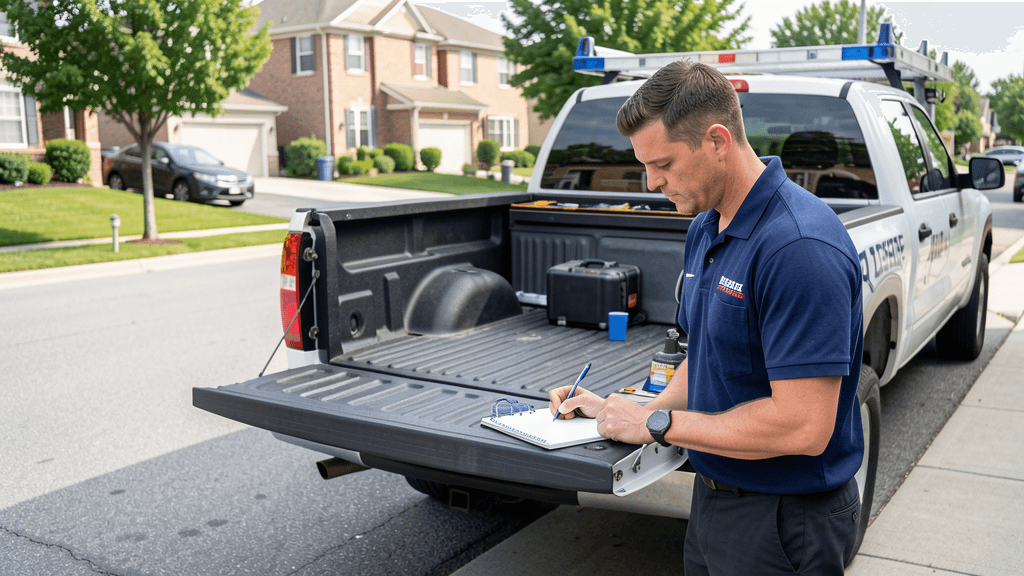
A three-person plumbing crew in suburban Columbus has run out of a box truck and a home garage for six years. The owner's wife books jobs from the kitchen table between school drop-offs. The truck holds fittings, a water heater, two boilers, and 40 feet of PEX. The garage holds the overflow. It costs nothing beyond what he already pays for his house.
Trade business office vs truck is a cost-stack decision with a breakeven revenue figure attached, not a lifestyle question. Most owners frame it as "am I ready for an office," which is backwards. The right frame: at what annual revenue does a leased space cost less than the drag of running from a truck, and what must the space do to earn that money back? Here is the framework for a 3-tech crew weighing it in 2026, with the real numbers behind it.
Trade Business Office vs Truck: What You Are Actually Paying For
An office is not a place to sit. A trade business owner sits in the truck 30 hours a week and on a customer's floor another 20. What the lease buys is four specific functions, and you should price each one separately before you sign anything.
The four functions a building serves
Parts and equipment storage. A box truck carries maybe $4,000 to $8,000 in rolling inventory. A real shop carries $20,000 to $60,000, which means you stock the part before the job instead of driving to the supply house twice a day. Every supply-house round trip is 45 to 90 minutes of billable time burned.
A fixed dispatch point. When techs start the morning at the shop instead of driving straight to the first job, you hold a 10-minute standup, hand out routes, and load material. For a 3-tech crew, the saved windshield time alone can be four to six billable hours a week.
A customer-facing address. Some commercial property managers and general contractors will not cut a check to a business with no physical address on the W-9. The office opens bid lists that a truck-only shop cannot get on.
A controlled work environment. Rebuilding a pump, brazing a coil, or assembling a custom manifold on a tailgate in January rain costs time and quality. A shop with heat, light, and a bench turns those into shop-rate work instead of field-rate work.
The Real Cost of a Leased Office for a 3-Tech Crew
A 1,200-square-foot industrial bay in a second-tier metro runs $14 to $22 per square foot annually, triple-net. Call it $18 per square foot, which is $21,600 a year in base rent, or $1,800 a month. Triple-net means you also pay taxes, insurance, and common-area maintenance on top, usually $3 to $6 per square foot, adding another $4,800 a year. So the floor cost before you turn a light on is roughly $26,400 a year, or $2,200 a month.
Then come the costs the broker does not itemize:
Buildout and security deposit. A bare bay needs a lockable parts room, shelving, a bench, and 220-volt service if you test equipment. That is $8,000 to $18,000 up front, plus first-and-last plus a security deposit equal to two months. You are writing a check for $15,000 to $25,000 before the first tech clocks in.
Utilities. Heat, power, water, and internet for a shop running compressors and lights runs $300 to $650 a month. The IRS treats utilities as a direct cost of a business space under Publication 587 on the business use of a home; the same logic applies to a leased bay, only bigger.
Hazardous-material compliance. If you store refrigerant, solvents, or fuel, your lease and your insurance both change. A 30-pound refrigerant cylinder and a parts-washer full of solvent trigger local fire-code storage rules and an environmental surcharge on your general liability policy. The EPA's Spill Prevention, Control, and Countermeasure rule covers oil and fuel storage above threshold volumes, and a shop storing drums of solvent or motor fuel needs to confirm it is under the reporting floor. Budget $600 to $1,200 a year for the compliance and insurance delta.
Added insurance. A building with a sign and a bay door raises your general liability and your property coverage. Expect $1,200 to $2,400 a year over a truck-only policy.
Add it up and the all-in cost lands near $36,000 to $42,000 a year for a modest bay. That is the number that has to clear the breakeven test.
What the Truck-Only Model Actually Costs You
Running from the truck is not free. It is just unbillable, which is worse, because it does not show up as a line item.
The hidden drag of no fixed base
Supply-house windshield time. Three techs making two supply-house runs a day at 60 minutes each is six hours a day, or 30 hours a week. At a blended shop rate of $95 an hour, that is $2,850 a week of potential billable time turned into driving, or roughly $140,000 a year in gross capacity you never invoice. A stocked shop does not eliminate this, but it cuts it by 60 to 70 percent.
Material waste and shrinkage. Inventory in three different trucks and two different garages gets lost, duplicated, and expired. A shop with one parts room and a count sheet shrinks that loss to near zero. Contractor overhead surveys from trade publications routinely put material shrinkage at 2 to 4 percent of material spend for unorganized shops.
Dispatch friction. When the person booking jobs is also loading the dishwasher, jobs get double-booked, techs get sent to the wrong address, and the first call of the morning goes to a cell phone that may not get answered. Every job that starts 30 minutes late because the route was not built the night before is a half-hour of margin gone.
That dispatch friction is also where call handling becomes a real cost. If you run from the truck and nobody is dedicated to the phone, inbound leads go unanswered and likely to a competitor. The options are a spouse or partner handling the line, a part-time CSR at $18 to $24 an hour, a human answering service at roughly $1 to $2 per call or $200 to $400 a month, or an AI receptionist like Heyfield at $49 to $199 a month. Each is a different bet on call volume; the point is that the truck-only model pushes this cost onto whatever is cheapest to bolt on, and the right answer depends on how many inbound calls you actually get in a week.
The home-office deduction ceiling. The IRS lets you deduct a home office, but only the percentage of the home used exclusively and regularly for business. A 200-square-foot garage office in a 2,000-square-foot house is 10 percent, which means you deduct 10 percent of mortgage interest, utilities, and insurance. It is a real deduction but a small one, and it does not scale. The moment the business outgrows the garage, the deduction stops growing with it.
When the Office Starts Paying for Itself
The breakeven question is the whole decision. Take the all-in shop cost of $38,000 a year as the midpoint. For the office to pay for itself, it has to generate $38,000 of gross margin that the truck-only model would not have generated.
Three ways the building earns it back
Recovered billable hours. If the stocked shop cuts supply-house driving by 18 hours a week across three techs, and you invoice even 12 of those hours at $95, that is $1,140 a week, or about $57,000 a year in new billed revenue. At a 40 percent gross margin, that is $22,800 of margin. That alone covers more than half the lease.
Material margin on stocked inventory. Buying fittings and parts in case quantities instead of piece quantities raises your material margin 5 to 12 percent. On $120,000 of annual material spend, that is $6,000 to $14,000 of margin recovered.
Commercial bid lists. A fixed address gets you onto property-manager and GC vendor lists that a truck-only shop cannot access. One recurring commercial contract at $4,000 a month with a 35 percent margin is $16,800 of annual margin. The building paid for itself on a single contract.
Stack those three and the building generates $45,000 to $53,000 of margin against $38,000 of cost. The rule of thumb: a 3-tech shop crossing roughly $450,000 to $550,000 in annual revenue is where the office clears breakeven on the recovered-hours and material-margin lines alone, before any commercial contract. Below that revenue, the building is a drag. Above it, the building is leverage.
Customer Perception: Do Homeowners Actually Care?
For residential work, the honest answer is no, not much. A homeowner hiring a plumber cares that the truck is clean, the tech is on time, and the price is fair. They do not drive past your shop. The U.S. Bureau of Labor Statistics tracks self-employment across skilled trades, and the dominant operating model for sub-$500K residential shops remains the home-based or truck-based business, precisely because the residential customer never sees the back office.
Where the address matters is commercial and insurance work. A property manager running 40 buildings wants a vendor with a shop they can send a parts delivery to, a place a loss-control inspector can visit, and an address that survives a corporate background check. If your growth plan includes recurring commercial contracts, the office is not optional. If your plan is to stay residential and stay at three techs, the office is a want, not a need.
The 6-Month Decision Review
If you take the lease, set a review date six months in and write the breakeven math on the wall. Track three numbers: billable hours recovered per week, material margin percentage change, and commercial revenue as a share of total. If all three are tracking toward the breakeven stack by month six, the building is doing its job. If recovered hours are flat because techs still run to the supply house, the building is a storage unit you are paying retail rent for, and the problem is inventory discipline, not square footage.
If you stay truck-only, the same review applies in reverse. Track the supply-house windshield hours, the material shrinkage estimate, and the number of commercial bids you lost for lack of an address. When those three costs together approach the $38,000 lease number, the truck has stopped being the cheaper option and it is time to move.
The decision is not permanent in either direction. The truck-only shop that hits $500,000 in revenue is the same shop that will find the lease obvious. The shop with the lease that stalls at $380,000 is the same shop that will find downsizing to a shared bay or a container the right call. Run the cost stack, find your breakeven revenue, and let the numbers tell you which year to move.
Frequently Asked Questions
At what revenue should a trade business lease an office instead of working from the truck?+
For a 3-tech crew, the breakeven typically lands around $450,000 to $550,000 in annual revenue, where recovered billable hours and material margin from stocked inventory cover the $36,000 to $42,000 all-in lease cost. Below that, the truck-only model is cheaper; above it, the building is leverage.
How much does a leased shop cost a trade business per year all-in?+
A 1,200-square-foot industrial bay in a second-tier metro runs roughly $36,000 to $42,000 a year once you add triple-net rent, utilities, buildout amortization, hazardous-material compliance, and added insurance. Base rent alone is around $26,400.
What does running from the truck actually cost a trade business?+
The biggest unbillable cost is supply-house windshield time. Three techs making two runs a day at 60 minutes each is 30 hours a week of lost billable capacity, roughly $140,000 a year at a $95 blended shop rate, plus 2 to 4 percent material shrinkage from scattered inventory.
Do residential customers care if a trade business has an office?+
Mostly no. Residential homeowners care about the truck condition, punctuality, and price. The address matters for commercial property managers, GCs, and insurance work that require a physical address for vendor onboarding and background checks.
Can a trade business still deduct a home office if it leases a shop?+
The IRS home-office deduction applies only to the part of the home used exclusively and regularly for business. Once you lease a shop, the deduction shifts to the leased space, which is a direct business expense rather than a percentage-of-home calculation.
How should a trade owner review the office decision six months in?+
Track three numbers: billable hours recovered per week, the change in material margin percentage, and commercial revenue as a share of total. If all three are moving toward the breakeven stack, the building is working; if recovered hours are flat, the issue is inventory discipline, not square footage.
What hazardous-material rules change when a trade shop leases a bay?+
Storing refrigerant, solvents, or fuel triggers local fire-code storage rules, an environmental surcharge on general liability insurance, and potentially EPA Spill Prevention, Control, and Countermeasure requirements if oil or fuel volumes exceed the reporting threshold. Budget $600 to $1,200 a year for the delta.
Is a shared bay or container a middle option between truck and full lease?+
Yes. A shared bay or a secure storage container gives you parts storage and a dispatch point without the full triple-net commitment, which suits shops between $380,000 and $450,000 in revenue that have outgrown the garage but are not yet at full-lease breakeven.
Ready to stop missing calls?
Try Heyfield free for 7 days. Your AI receptionist answers every call, collects customer details, and texts you the summary.
Keep Reading
Locksmiths: Your Most Valuable Calls Come After Midnight
Locksmiths lose $3,000+ every month to missed after-hours calls. Here's what that's costing you — and the simple fix.
ReadDeck Builders: Stop Losing $90K Every Spring
Deck builders miss 2-3 quote calls a week during peak season. Here's the real revenue cost—and how to fix it without hiring a receptionist.
Read