IRA Insulation Rebates 2026: Customer Documentation Guide

Meric Karpat · Founder & CEO
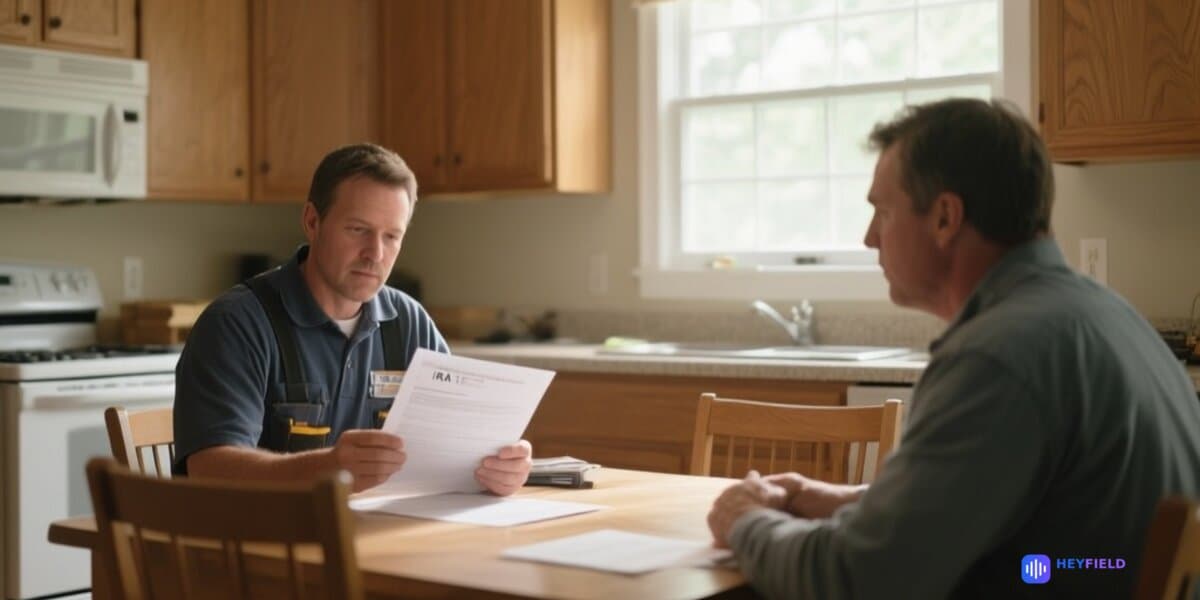
It is Tuesday morning and your insulation crew is pulling up to a 1950s ranch with single-pane windows and zero attic insulation. The homeowner meets you at the door with a printout from Facebook: "My cousin said I can get $1,600 back if I insulate before December. Is that true?" If your answer is "I think so, you should ask your accountant," you have already lost some of the trust that got you the bid. Homeowners in 2026 are researching rebates before they research R-values. The crew that can speak confidently about IRA insulation rebates — and hand the customer the right paperwork — wins the job over the crew that shrugs.
IRA insulation rebates 2026 customer documentation is not something you can wing. The Inflation Reduction Act created multiple home-energy incentive programs, and each one has different rules about who qualifies, what work counts, and what paperwork the homeowner needs to keep. This guide is written for insulation contractors who want to close more jobs by helping homeowners claim money they are already entitled to — without turning your truck into a tax-preparation office.
IRA Insulation Rebates 2026 Customer Documentation: What Your Crew Needs to Know
There are three federal and state programs insulation contractors run into on sales calls. The Energy Efficient Home Improvement Credit, commonly called 25C, is a federal tax credit. The HOMES rebate program and the HEEHRA rebate program are administered by individual state energy offices. Each program has its own customer documentation requirements, and mixing them up is the fastest way to get a rebate denied.
Most insulation jobs your crew performs in existing homes qualify for the federal home energy improvement credit if the material meets the 2009 International Energy Conservation Code or later. That covers blown-in cellulose, spray foam, batt insulation, and air-sealing work done in attics, walls, crawl spaces, and rim joists. New-construction jobs do not count. Neither do purely cosmetic repairs like wrapping ducts in foil tape without sealing the leaks underneath.
The federal credit is worth 30% of the project cost, capped at $1,200 per year across all qualifying improvements combined. If your customer already replaced two exterior doors in March, the attic insulation you install in October may be competing for what is left of that $1,200 annual pot. That is why you ask about other energy upgrades before you quote. It keeps your estimate grounded and prevents the homeowner from blaming you when their tax preparer says the credit is already exhausted.
On the state side, HOMES rebates can cover 50% of project costs or more for households that achieve modeled or measured energy savings. HEEHRA rebates target low-to-moderate-income households and are usually reserved for electrification measures like heat pumps and heat-pump water heaters. Insulation rarely qualifies for HEEHRA on its own, but it can when bundled into a whole-home electrification package. The Department of Energy maintains a searchable database of which states have launched their rebate portals and what the current enrollment status is.
What Insulation Work Qualifies Under the IRA in 2026
For the Energy Efficient Home Improvement Credit to apply, the work must be done in an existing primary residence. Rental properties and second homes do not qualify. The homeowner must own the property and live in it at least part of the year. The material itself has to be installed by you or another contractor; DIY installs that the homeowner buys off the shelf do not count, because the tax code requires the labor to be performed by a qualified contractor.
Beyond the insulation material, air sealing is also credit-eligible when it is bundled with insulation or performed as part of a whole-home weatherization scope. Common qualifying items include caulk and expanding foam around top plates, behind electrical boxes, and along chimney chases. The key is that the air-sealing work has to be incidental to the insulation job or part of a blower-door-guided package. Standalone caulking of a window frame does not trigger the credit.
Insulation tax credit 2026 rules are largely unchanged from 2025, but enforcement has tightened. The IRS is running more audits on residential energy credits, which means homeowners need better documentation than they did two years ago. Contractors who treated invoices as afterthoughts are now getting panicked emails from customers who cannot find the product name or installation date twelve months later. The ones who sent clear, dated paperwork at closeout are not getting those calls.
The Three Rebate Programs Homeowners Keep Mentioning
Homeowners do not distinguish between programs. They just hear "rebate" and expect you to know the rest. Here is the three-program breakdown you should print on an index card and keep on your clipboard:
1. Energy Efficient Home Improvement Credit (25C). This is the federal tax credit. The homeowner pays you full price and claims 30% back when they file taxes, up to the $1,200 annual cap. You do not handle the money. Your job is to give them a detailed invoice that lists the insulation material, its cost, the installation labor separately, and the date of completion. The IRS does not require contractors to be certified under 25C, but the invoice needs to be clear enough that an auditor can see exactly what was purchased and when.
2. HOMES Rebate Program. This is a performance-based rebate administered by states. It pays homeowners based on modeled or measured energy savings, often covering 50% of project costs up to set caps. Not all states have rolled out HOMES, and the contractor often needs to be enrolled in the state program to participate. If your state is live and you are enrolled, this can unlock the biggest per-project checks.
3. High-Efficiency Electric Home Rebate Act (HEEHRA). Also state-administered and income-capped, this program targets electrification measures like heat-pump HVAC and heat-pump water heaters. Insulation can qualify when it is part of an integrated package with an electrification upgrade, but standalone insulation jobs rarely trigger HEEHRA. Homeowners routinely get HEEHRA confused with the insulation-specific credits. Your job is to clarify, not mislead.
State energy rebate insulation programs vary by jurisdiction. A customer in Massachusetts may have a robust HOMES portal with same-week approvals, while a customer in Mississippi may have no active program at all. Always verify current status on your state energy office website before you quote a rebate-inclusive price.
What Your Customer Needs to Bring You (and What You Give Back)
Most homeowners show up unprepared. They heard about "that government money" on a podcast and assumed the contractor handles everything. You need an intake checklist that tells the customer exactly what they need to have ready before you arrive to measure:
- A recent property tax bill or utility bill in their name, proving ownership and occupancy.
- The most recent federal tax return (first two pages only), so you or their tax preparer can confirm they are under the income cap for income-based rebates.
- A list of any other energy improvements done in the current tax year, because the $1,200 annual credit is shared across categories.
- Approval from their mortgage lender or HOA if the work affects exterior walls in a multi-unit building.
What you give back matters just as much. Every insulation job that might qualify for a rebate should leave the customer with three documents: a detailed invoice that separates material from labor and includes the manufacturer and product name of the insulation; a dated photo log showing the area before and after install; and a short summary sheet you printed from the Department of Energy or your state energy office explaining which program the work likely qualifies for and who to contact next.
Contractor rebate paperwork is the invisible half of the job. Homeowners will forget what product you installed and whether you air-sealed the top plates. If you do not document it for them, the rebate claim fails. If you do document it, the next time the neighbor asks for a referral, your customer remembers you as the one who had everything organized.
How to Document the Job So the Rebate Does Not Get Denied
Rebate denials happen because the paperwork does not match the work, not because the insulation was installed poorly. Here is the documentation stack that protects both you and the homeowner:
Pre-install photos. Walk the attic or crawl space with your phone and shoot wide angles of the existing insulation, or lack thereof. Include a photo of the access door and any framing members that will affect coverage. These photos prove the home genuinely needed the work and establish a baseline for the home energy improvement credit claim.
Material specification sheet. Keep the bag label or product cut sheet for the insulation you installed. The IRS wants to see that the material meets IECC 2009 or later standards. If you are using blown-in cellulose, know the R-value per inch and the minimum depth achieved.
Invoice separation. Do not lump insulation and unrelated repairs onto one line item. The invoice should read: "Attic insulation — blown cellulose, 12 inches, R-49 — $1,850. Air-sealing around chimney chase and top plates — $340." Labeled line items make it easy for an accountant or state rebate processor to verify eligibility without calling you for clarification.
Post-install blower-door test (if required). Some state HOMES programs require a pre- and post-installation blower-door test to prove air leakage reduction. If your state requires it, schedule the pre-test before you remove the old insulation, and the post-test after air-sealing is complete. The homeowner may need to pay for the test out of pocket, but the rebate often covers it. Charge for your time to coordinate the testing, or partner with a local energy auditor and mark up the referral.
Contractor Enrollment: Do You Need to Be "Approved"?
For the federal tax credit, you do not need to enroll anywhere. Any licensed contractor can perform qualifying work. The homeowner claims the credit, and the IRS does not ask for your certification.
For state-administered HOMES and HEEHRA rebates, the rules change. Many states require contractors to complete a short training module, carry general liability insurance above a minimum threshold, and sign an agreement to follow program standards. The enrollment process is usually free and takes less than two hours online, but you have to seek it out. Search your state energy office website for "IRA rebate contractor enrollment" or call the number on the Department of Energy state-program map.
If you are not enrolled and the homeowner tries to claim a HOMES rebate, the application may be rejected outright. Worse, the homeowner may blame you. They do not understand the distinction between a federal tax credit and a state rebate; they just know they hired you to insulate and now the rebate is gone.
Talking About Rebates on the Sales Call Without Overpromising
The most dangerous sentence in insulation sales is "You will definitely get $1,600 back." You do not know their tax liability. You do not know whether they already claimed a heat-pump credit this year. What you can say is this:
"Based on what you have told me, this insulation job is likely to qualify for the federal Energy Efficient Home Improvement Credit, which is worth up to 30% of the material and install cost, with a $1,200 annual cap. The exact amount depends on your tax situation and what else you have claimed this year. I will give you an invoice that lists everything your accountant needs, and I will also email you the link to your state rebate page so you can check what other programs you might stack on top."
That script does three things. It gives a specific range instead of a promise. It hands off tax advice to the accountant — protecting you from liability. And it shows you are organized enough to have prepared materials, which is often the real reason homeowners choose one contractor over another.
What Has Changed by Mid-2026
The Energy Efficient Home Improvement Credit is still active through 2032 under the Inflation Reduction Act, so the structure has not changed. What has shifted is enforcement. Through the first half of 2026, the IRS has continued increasing audits of residential energy credits, which means homeowners are more likely to be asked for documentation. Contractors who have been sloppy with invoices are now getting calls from panicked customers a year after the job. The ones who sent detailed, dated paperwork at closeout are heroes.
On the state side, more states launched HOMES and HEEHRA portals through late 2025 and the first half of 2026. That means more customers are aware of the programs, but it also means funds are being drawn down faster. Several states have paused applications pending new appropriations as of July 2026. Check your state energy office quarterly so you are not quoting a rebate that no longer exists. The Department of Energy database is updated roughly every two weeks with enrollment and pause notifications.
Six Months Out: Are Rebates Converting to More Jobs?
If you are tracking where your leads come from, add a line for "rebate inquiry." After six months, look at the data. Are homeowners who ask about rebates more likely to close? Do they tolerate higher estimates because they expect a partial refund? Do they refer more friends because you knew the paperwork? Most insulation contractors who track this find that rebate-aware customers close 15% to 25% faster and refer at a higher rate — not because the rebate is huge, but because the contractor who explains it looks like the expert in the room.
The real return is not the rebate itself. It is the trust you build when the homeowner realizes you have already thought about the part of the job they are most confused by. That trust turns a one-day attic job into a whole-house weatherization project, a roof-insulation upsell, and a referral to the neighbor whose utility bill just doubled.
IRA insulation rebates 2026 customer documentation is your edge. The crew that hands over a clean invoice, a photo log, and a printed summary sheet walks out with more than a check. They walk out with credibility that compounds into the next job.
This guide is published by Heyfield, which makes an AI phone receptionist for home-service trade businesses. If you ever can't take the call, that's what we do. See pricing. The rest of our trade-business resources are free at heyfield.app/blog.
Frequently Asked Questions
How often should I recalibrate my pricing book for insulation material swings?+
At least once per quarter, or immediately after a supplier price-change notice. Cellulose and fiberglass prices move with oil and resin markets, so a 60-day lag is common. Track your most-used SKUs on a spreadsheet and update per-square-foot installed rates when the materials variance exceeds 8%.
Pricing-by-the-hour vs flat-rate for insulation bids — which fits a 2-person crew?+
Flat-rate insulation bids protect you from variance on old homes where access is unpredictable. Hourly rates work better for large commercial jobs with defined scopes. For residential retrofits, the 2-person crew should quote flat-rate per square foot with an access-difficulty surcharge built in, because attic clearances and knee-wall framing can double labor time without warning.
What licenses do I need to bid insulation work in California?+
California requires a C-2 Insulation and Acoustical Contractor license for thermal insulation installation. Some municipalities also require hazardous-materials registration if you are removing old vermiculite or asbestos-containing insulation. Always pull a building permit for open-wall or attic insulation work; the permit is the homeowner's proof that the install was done by a licensed professional, which is required for some rebate programs.
Does the federal insulation tax credit apply to crawl space encapsulation with a vapor barrier?+
Crawl space encapsulation with a vapor barrier is not explicitly listed as a qualifying measure under the Energy Efficient Home Improvement Credit. However, if the encapsulation work is bundled with air sealing and insulation of the crawl space walls or rim joists, the qualifying portion may still be eligible. Separation of line items is critical so the auditor can identify which costs relate to insulation and air sealing versus moisture management alone.
At what income level does a household switch from HEEHRA to the standard HOMES rebate program?+
HEEHRA rebates are capped at 150% of area median income. Households above that threshold do not qualify for HEEHRA and should look at HOMES, which has no strict income cap but pays based on modeled or measured energy savings. The exact income threshold varies by county and household size, so contractors should refer homeowners to the state energy office calculator rather than guessing.
Can I stack the federal tax credit with a state HOMES rebate on the same insulation job?+
Yes. The federal Energy Efficient Home Improvement Credit is claimed on taxes, while HOMES is a direct point-of-sale or post-install rebate administered by the state. They are separate pools of money. The federal credit does not reduce the HOMES rebate amount, or vice versa, as long as each program's documentation requirements are met independently.
What is the script for asking a customer to leave a Google review after an insulation install?+
Send a text within 48 hours of completion: "Hi [Name], the crew finished your attic insulation yesterday. If you noticed a difference in comfort today, would you mind sharing that on Google? It helps other homeowners find us. Here is the link: [URL]. Thanks — [Your name]." Keep it to one sentence of context and one request. Photos of the finished work attached to the text increase review conversion by roughly 30%.
How do I handle a rebate denial caused by missing documentation when the job was completed six months ago?+
If you kept a photo log, dated invoice, and product specification sheet at closeout, you can email the complete packet to the homeowner in under five minutes. If you did not keep documentation, there is usually no recourse, because most rebate programs require proof of what was installed and when. Use this as a systems incentive to standardize your documentation workflow going forward.
Should I build a separate price sheet just for rebate-qualified jobs?+
Do not create two price sheets, because rebate status is determined by the homeowner's tax and income situation, not by the contractor's pricing. Instead, keep one standard price sheet and add a line at the bottom: "Federal and state energy rebates may offset 30% to 50% of project cost depending on eligibility. We provide documentation to support your claim." That keeps pricing transparent while reminding the customer that rebates are available without making them conditional on rebate approval.
Does Heyfield work with ServiceTitan?+
Heyfield connects to ServiceTitan through its API, pulling customer records and appointment details so the AI receptionist can schedule appointments directly into your existing dispatch board. The integration takes about ten minutes to set up from the Heyfield dashboard.
Ready to stop missing calls?
Try Heyfield free for 7 days. Your AI receptionist answers every call, collects customer details, and texts you the summary.
Keep Reading
Why Welding Shops Can't Risk Answering Their Own Phones
Sparks fly, face shields go down, and phone calls go to voicemail. How safety-first welding shops lose business to missed calls.
ReadPool Service Owners: Every Missed Call Costs You $900
Pool season is short and winterization is now. One missed call can cost you a full-season client worth $900+. Here's how solo pool service pros stop losing jobs to voicemail.
Read