Panel Upgrade Quoting Formula 2026: 6 Steps to $4K-$12K

Meric Karpat · Founder & CEO
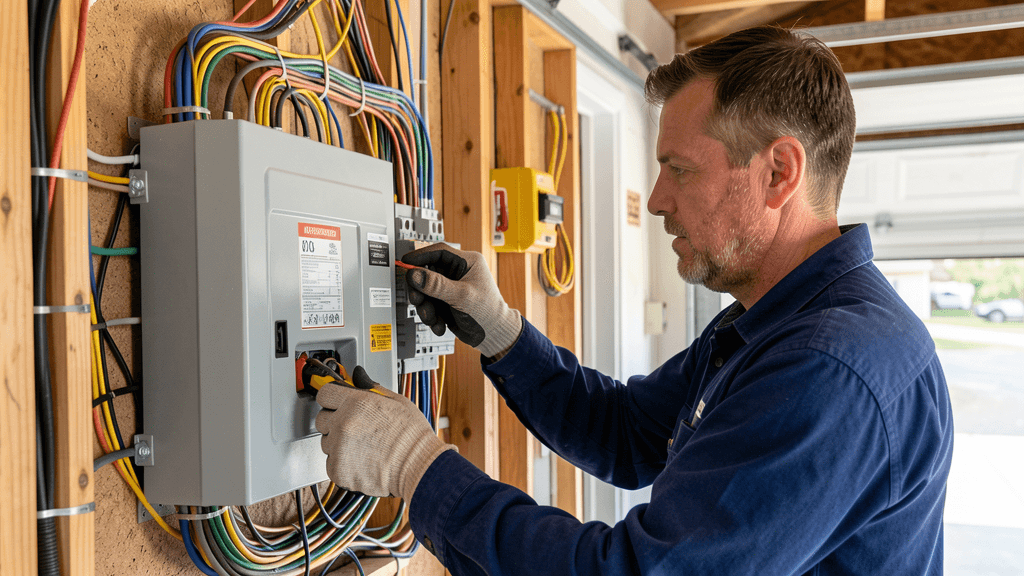
You get a call from a homeowner who wants to upgrade their 100-amp fuse panel to a 200-amp breaker panel. They ask what it costs. If you throw out a number from memory, you will either lose the job to the next electrician who quotes $300 less, or you will win the job and lose money on materials you did not price.
A panel upgrade quoting formula 2026 is not a price sheet. It is a six-step build-up that starts with the panel type, adds labor hours, layers in permit and inspection costs, accounts for the hidden materials that always show up, and lands on a flat-rate number you can hand the homeowner with confidence. This guide walks through each step using real 2026 cost ranges so you can quote a $4,000 service-panel swap or a $12,000 main service upgrade without guessing.
An electrical panel upgrade is one of the most common high-ticket jobs an electrician quotes. The U.S. Bureau of Labor Statistics reports the median wage for electricians was $34.26 per hour in May 2024, with the top 10 percent earning more than $58.00 per hour. Your billing rate should reflect your actual cost of doing business, not the median wage. But the formula below works whether your fully loaded labor rate is $85 per hour or $145 per hour.
Step 1: Identify the Panel Type and Amperage
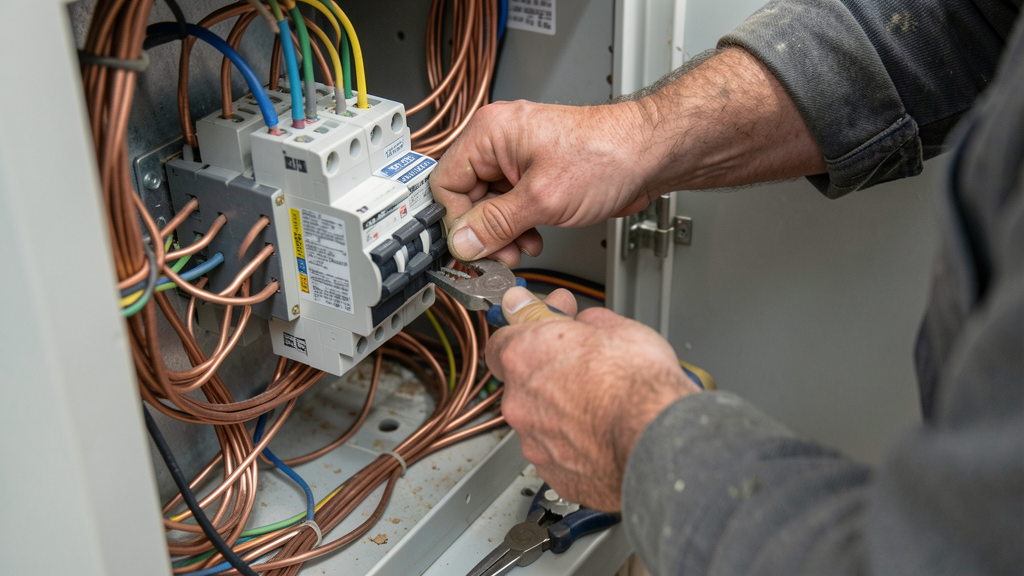
Every panel upgrade quote starts with one question: what are you pulling out and what are you putting in? The panel type drives 60 percent of your material cost and 40 percent of your labor hours.
The four most common residential panel upgrades in 2026
100-amp to 200-amp breaker swap (most common): The existing panel is a 100-amp breaker box, and the homeowner wants 200 amps for an EV charger, heat pump, or addition. You are swapping the panel, upgrading the service entrance cable, and possibly upsizing the grounding system. Material cost: $400-$700 for the panel, breakers, and main breaker. Labor: 6-8 hours.
Fuse panel to breaker panel conversion (also called a fuse-to-breaker conversion): The home still has a screw-in fuse panel. This requires a full panel replacement, new breaker set, and almost always a grounding upgrade to meet NEC 250 grounding requirements. Material cost: $500-$900. Labor: 7-10 hours because old fuse boxes often have degraded wiring that needs re-terminating.
200-amp to 400-amp service upgrade: Large homes with multiple AC units, EV chargers, and workshops. This is a service-level upgrade, not just a panel swap. You are replacing the meter base, service entrance conductors, and grounding electrode system. Material cost: $1,200-$2,500. Labor: 10-14 hours.
Sub-panel addition off an existing 200-amp main: The homeowner needs a sub-panel in a detached garage or finished basement. Material cost: $250-$500 for the sub-panel, breakers, and feeder cable. Labor: 4-6 hours.
Step 2: Calculate Labor Hours by Panel Type
Labor is where most electricians underquote. You know how long it takes you to swap a panel, but do you account for the drive time to the supply house, the 45 minutes the inspector makes you wait, and the 30 minutes you spend explaining the work to the homeowner?
Labor hour build-up for a 100-to-200-amp panel swap
Break it into phases and track the hours:
- Site visit and assessment: 1 hour (load calculation, panel location check, service entrance cable measurement)
- Material pickup: 1 hour (drive to supply house, load the truck)
- De-energize and remove old panel: 1.5 hours (disconnect from meter, remove old panel, prep the mounting surface)
- Mount new panel and connect service entrance: 2 hours (mount panel, connect SEC, install main breaker)
- Circuit migration: 1.5 hours (re-terminate each circuit, label breakers)
- Grounding and bonding: 1 hour (install grounding electrode conductor, bond water pipe if present, bond gas pipe per NEC 250.104)
- Inspection wait and walkthrough: 1 hour (wait for inspector, fix any callouts, walkthrough with homeowner)
That is 9 hours total for what feels like a 6-hour job. At a $95 per hour fully loaded labor rate, that is $855 in labor alone. If you quoted $600 for labor because you only counted the on-site time, you just lost $255.
Step 3: Add Permit and Inspection Costs by Jurisdiction
Permit costs vary wildly. The electrical permit cost varies by jurisdiction. In some counties, an electrical panel permit is $35. In others, it is $250. You need to know your jurisdiction's fee schedule before you quote.
Typical 2026 permit cost ranges
According to data from the National Electrical Contractors Association (NECA), permit fees for residential panel upgrades range from $35 to $300 depending on jurisdiction, with a national median around $85. Some municipalities also require a separate utility disconnect permit ($25-$75) and a grounding inspection ($15-$50).
Always pass the permit cost through to the homeowner as a line item, not buried in your flat rate. If the permit costs $150 and you bury it in your labor, you are eating $150. If the inspector requires a re-inspection because the grounding clamp is the wrong size, that is another $50-$100 in re-inspection fees.
Utility coordination time
If you are upgrading the service entrance, the utility company may need to schedule a disconnect and reconnect. In some areas, this is same-day. In others, it requires a two-week lead time and a $200-$500 utility fee. Build that into your timeline and quote it as a pass-through.
Step 4: Account for Hidden Materials That Eat Your Margin
This is where electricians lose money. You quote the panel, the breakers, and the service entrance cable. Then you get to the job and discover three things you did not price:
The five most common hidden materials
- Grounding electrode conductor upgrade: If the existing grounding system is #4 copper and the new 200-amp service requires #2 copper per NEC 250.66, that is $45-$80 in additional cable and clamps.
- Bonding jumpers for gas and water pipes: NEC 250.104 requires bonding of metal water and gas piping. If the existing bonding is missing or undersized, you need $25-$60 in bonding clamps and #4 copper jumpers.
- Schedule 80 PVC or EMT for service entrance: If the existing raceway is damaged or too small, you need $30-$80 in conduit, connectors, and straps.
- Arc-fault and GFCI breakers: NEC 210.12 requires AFCI protection on most 15- and 20-amp circuits in dwelling units. If the old panel had standard breakers, upgrading to AFCI/GFCI breakers adds an AFCI breaker cost of $35-$60 per breaker. On a 20-circuit panel, that is $700-$1,200 in breakers alone.
- Meter base upgrade: If the utility requires a new meter base for the 200-amp service, that is $80-$150 in material plus 1-2 hours of additional labor.
On a recent 200-amp upgrade in Texas, an electrician quoted $3,200 based on the panel, breakers, and 8 hours of labor. The hidden materials (AFCI breakers, grounding upgrade, bonding, meter base) added $1,150. The job cost $4,350 to complete, and the electrician ate the difference.
Step 5: Apply Your Markup to Complete the Panel Upgrade Quoting Formula 2026
Now you have your three cost buckets: labor, materials, and permits. Add them up and apply your markup.
The flat-rate build-up formula
Total labor cost = labor hours x your fully loaded hourly rate
Total material cost = panel + breakers + service entrance cable + grounding + bonding + conduit + AFCI/GFCI breakers + any meter base
Permit and inspection cost = electrical permit + utility fees + re-inspection buffer ($50)
Subtotal = labor + materials + permits
Markup = subtotal x 15-25 percent (your overhead and profit margin)
Flat rate to homeowner = subtotal + markup + sales tax on materials
Example: 100-to-200-amp panel swap
Labor: 9 hours x $95 = $855
Materials: $650 (panel + standard breakers) + $850 (AFCI/GFCI breakers, grounding, bonding, conduit) = $1,500
Permits: $85 + $50 buffer = $135
Subtotal: $2,490
Markup at 20%: $498
Flat rate: $2,988 + sales tax on materials
That is a $3,000 job for a straightforward 100-to-200-amp swap. For a fuse-to-breaker conversion with degraded wiring, the same formula with 10 labor hours and $2,000 in materials lands at $4,200. For a 200-to-400-amp service upgrade with 14 labor hours and $2,500 in materials, you are at $6,800 to $8,000 before the utility-side work.
Step 6: Present the Quote and Set Expectations
How you present the quote matters as much as the number. A handwritten number on a business card signals that you are guessing. Flat rate pricing for electricians signals professionalism. A printed or emailed quote with line items signals that you have a system.
Quote presentation checklist
- Line-item the labor, materials, and permit separately so the homeowner sees what drives the cost. If they question the price, you can point to the AFCI breaker line and explain NEC 210.12.
- Note what is excluded: drywall repair, trenching for underground service, and tree trimming for overhead service drops. These are common add-ons that should be priced separately.
- Include a re-inspection buffer: If the inspector calls out a fix, you are not eating that cost. A $50-$100 line item covers it.
- State the payment terms: 50 percent deposit to schedule, balance on final inspection. This is standard for panel upgrades and prevents you from chasing payment after the inspector signs off.
- Set the timeline: Permit lead time, utility coordination, and the actual install day. If the utility needs two weeks to schedule a reconnect, tell the homeowner upfront.
How to Handle the Homeowner Who Says "That Is a Lot More Than My Neighbor Paid"
Every electrician hears this. The neighbor paid $1,800 because they got a handyman who swapped the panel without permits, without AFCI breakers, and without upgrading the grounding. Your $3,000 quote includes $1,350 in code-compliant materials and permits that the $1,800 job skipped.
The right response is not to drop your price. It is to explain what the $1,200 difference buys: a permitted installation that passes inspection, AFCI breakers that meet NEC 210.12, a grounding system that meets NEC 250.66, and a re-inspection guarantee. If the homeowner still wants the $1,800 price, they are not your customer.
When to Walk Away From a Panel Upgrade Job
Not every panel upgrade is worth taking. Walk away if:
- The home has aluminum branch wiring that needs full replacement, not just re-termination. That is a whole-house rewiring job, not a panel upgrade.
- The service entrance is underground and the utility requires you to trench 30 feet of new conduit. The trenching cost can exceed the panel cost.
- The homeowner wants to reuse existing breakers in a new panel. Different manufacturers are not interchangeable, and mixing brands voids the listing.
- The panel is in a finished ceiling or a tight closet that requires demolition to access. Add demolition and drywall repair to the quote, or walk.
Recalibrating Your Formula Every 6 Months
Material prices move. Copper wire went up 8 percent between January 2025 and June 2025, according to pricing data from CRU, a commodity research firm. Panel prices from Square D, Siemens, and Eaton adjust quarterly. Your quoting formula should be recalibrated every six months using current supply house pricing.
Keep a spreadsheet with your three cost buckets (labor, materials, permits) and update the material prices each January and July. If copper spikes or a new NEC code cycle adds requirements, your formula absorbs it without you having to remember to add $80 for a grounding upgrade you forgot to price.
The electricians who lose money on panel upgrades are not the ones who charge too little. They are the ones who do not have a formula. A panel upgrade quoting formula 2026 update with real numbers takes 10 minutes to run and protects your margin on every job.
This guide is published by Heyfield, which makes an AI phone receptionist for home-service trade businesses. If you ever can't take the call, that's what we do. See pricing. The rest of our trade-business resources are free at heyfield.app/blog.
Frequently Asked Questions
How often should I recalibrate my panel upgrade quoting formula?+
Every six months. Material prices for copper wire, AFCI breakers, and panels move quarterly, and NEC code updates can add requirements. Pull current supply house pricing in January and July to keep your formula accurate.
What is the biggest hidden cost electricians miss when quoting a panel upgrade?+
AFCI and GFCI breakers. NEC 210.12 requires arc-fault protection on most 15- and 20-amp dwelling circuits. If the old panel had standard breakers, upgrading to AFCI breakers adds $35-$60 per breaker, which can total $700-$1,200 on a 20-circuit panel.
How do I price a fuse-to-breaker panel conversion differently from a breaker-to-breaker swap?+
A fuse-to-breaker conversion typically takes 7-10 labor hours versus 6-8 for a breaker swap, because old fuse boxes often have degraded wiring that needs re-terminating. Material cost runs $500-$900, and you should always budget for a grounding system upgrade to meet NEC 250 requirements.
Should I pass permit costs through to the homeowner or bury them in my flat rate?+
Always pass permit costs through as a line item. If you bury a $150 permit in your labor and the inspector requires a $100 re-inspection, you eat that cost. Line-iteming permits also lets the homeowner see exactly what drives the total.
What NEC code sections affect panel upgrade pricing in 2026?+
NEC 250.66 governs grounding electrode conductor sizing, NEC 250.104 requires bonding of metal water and gas piping, and NEC 210.12 requires AFCI protection on most dwelling circuits. All three can add material costs that did not exist on the previous panel installation.
How do I handle a homeowner who says their neighbor paid $1,800 for the same job?+
Explain what the price difference buys: a permitted installation, AFCI breakers meeting NEC 210.12, proper grounding per NEC 250.66, and a re-inspection guarantee. The $1,800 job likely skipped permits and code-compliant materials. If they still want the lower price, they are not your customer.
When should I walk away from a panel upgrade job?+
Walk away if the home has aluminum branch wiring needing full replacement, if the underground service requires extensive trenching, if the homeowner wants to reuse breakers from a different manufacturer, or if the panel location requires demolition to access.
What markup percentage should I apply to a panel upgrade quote?+
Most electrical contractors apply 15-25 percent markup on the subtotal of labor, materials, and permits. This covers overhead (insurance, truck payment, tool depreciation) and profit. Solo operators can work at 15-20 percent; shops with multiple trucks typically need 20-25 percent.
Ready to stop missing calls?
Try Heyfield free for 7 days. Your AI receptionist answers every call, collects customer details, and texts you the summary.
Keep Reading
Why Welding Shops Can't Risk Answering Their Own Phones
Sparks fly, face shields go down, and phone calls go to voicemail. How safety-first welding shops lose business to missed calls.
ReadPool Service Owners: Every Missed Call Costs You $900
Pool season is short and winterization is now. One missed call can cost you a full-season client worth $900+. Here's how solo pool service pros stop losing jobs to voicemail.
Read