Pool Service Pricing Route Density: The Real Margin Math

Meric Karpat · Founder & CEO
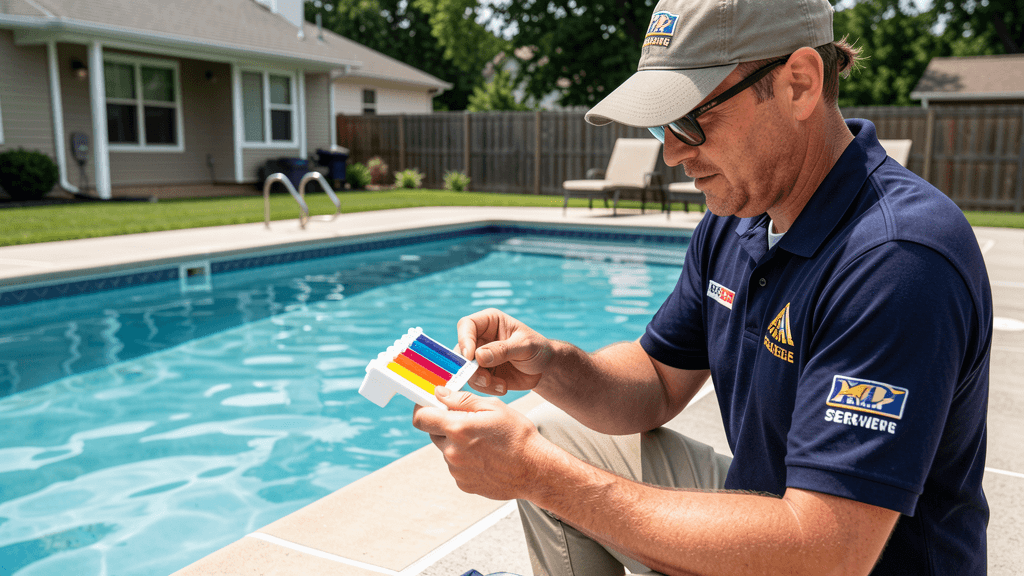
You run a pool route with 22 weekly accounts. Three are clustered in one subdivision, five are scattered across a 12-mile radius, and the rest fall somewhere in between. On a good Monday you finish 18 stops by 4:30 PM. On a bad one, you hit 14 and drive home in the dark wondering why the day felt long but the cash drawer felt light.
The answer is pool service pricing route density, and it is the single biggest factor separating pool techs who net $60,000 a year from those who net $40,000 working the same number of hours.
Most pool techs price by the pool. They look at what the guy down the street charges, match it, and start cleaning. That approach works fine when your stops are close together. It falls apart when your route looks like a Jackson Pollock painting on Google Maps.
The PHTA (Pool and Hot Tub Alliance) reports that the average independent pool tech services 20-30 pools per week. But the spread between efficient and inefficient routes is wide. A tech with 35 pools packed into two zip codes can finish by 2 PM. A tech with 20 pools spread across four towns might still be driving at 6.
What pool service pricing route density actually means
Route density is the number of pools you service per square mile of driving. A route with 30 pools in a 5-square-mile area has a density of 6 pools per square mile. A route with 20 pools spread across 25 square miles has a density of 0.8.
The density number matters because drive time is unpaid time. Every minute between pools is a minute you are not billing for. At $25 per stop and 15 minutes of driving between stops, you are earning $100 per hour of work but only $67 per hour on the clock including drive time. Density closes that gap.
Quick measurement: Pull up your route in Google Maps on a typical Monday. Add up the total drive time between stops. If you service 20 pools and spend 10 minutes driving between each, that is 190 minutes of driving, or 3 hours and 10 minutes of unpaid time. At 20 minutes between stops, that becomes 380 minutes, or 6 hours and 20 minutes. That difference is $200 in lost earning capacity on a single day.
The per-stop math: how drive time eats your margin at 10 pools per day
Let us break down a 10-pool day with a $25 per-stop average and 20 minutes of driving between each stop. This is the reality for a new route or one that has not been optimized.
Total stop time: 10 pools times 25 minutes of work per stop = 250 minutes (4 hours 10 minutes)
Total drive time: 9 gaps times 20 minutes = 180 minutes (3 hours)
Total day: 7 hours 10 minutes
Revenue: $250
Effective hourly rate: $35.21 per hour on the clock
Now subtract chemical costs. A typical weekly service stop uses $2.50 to $4.00 in chemicals (chlorine tabs, acid, conditioner, test reagents). At $3.00 average, that is $30 per day. Your real revenue drops to $220. Your effective rate drops to $30.77 per hour. Factor in gas, insurance, and equipment depreciation, and you are below $25 per hour net.
Drive time as a percentage of revenue
On that 10-pool day, drive time consumes 42% of your total working hours. That is nearly half your day spent in the truck generating zero revenue. The BLS reports that the median hourly wage for grounds maintenance workers is $18.68. If your net effective rate after expenses is $22-$25 per hour, you are barely outpacing unskilled grounds work, despite owning a business, a truck, and $3,000 in equipment.
Chemical cost per stop
Chemical cost is the one variable most new pool techs underestimate. The PHTA service standard calls for testing pH, total alkalinity, calcium hardness, and stabilizer levels weekly. A tech following that protocol uses roughly $3-$4 in chemicals per stop on a saltwater pool and $4-$6 on a chlorine pool with heavy summer demand. If you are charging $25 per stop and spending $5 on chemicals, your gross margin per stop is $20. Drive 20 minutes to earn $20 and your margin per hour of drive time is $60. Drive 5 minutes and it is $240.
What changes at 20 stops per day
A 20-stop day looks different. Same $25 average per stop, but now your route is tighter. You have been building density in two zip codes for six months. Drive time between stops drops to 8 minutes.
Total stop time: 20 pools times 25 minutes = 500 minutes (8 hours 20 minutes)
Total drive time: 19 gaps times 8 minutes = 152 minutes (2 hours 32 minutes)
Total day: 10 hours 52 minutes
Revenue: $500
Chemical cost: $60
Net revenue: $440
Effective hourly rate: $40.51 per hour on the clock
Drive time dropped from 42% of your day to 23%. Your effective rate went from $30.77 to $40.51. That is a 32% improvement from density alone. No price increase. No new service offering. Just shorter drives.
The catch: 10 hours 52 minutes is a long day. Most solo techs cap out at 20-22 stops. Beyond that, you need either shorter per-stop times (which comes with experience and better equipment) or a second person.
The 35-stop day: where the numbers break
A 35-stop day is the gold standard for profitable pool routes. It requires either a second tech or an experienced solo tech with a tight route, commercial-grade equipment, and automated chemical dispensing. Here is what the math looks like at 5 minutes between stops and 20 minutes per stop (a fast tech with good gear):
Total stop time: 35 times 20 minutes = 700 minutes (11 hours 40 minutes)
Total drive time: 34 gaps times 5 minutes = 170 minutes (2 hours 50 minutes)
Total day: 14 hours 30 minutes (split across two techs, 7 hours 15 minutes each)
Revenue: $875
Chemical cost: $105
Net revenue: $770
Drive time is now 19% of the day. Effective rate per on-clock hour is $53.10. But this only works with two techs in one truck or two techs in two trucks splitting the route. The economics flip if you have to pay a second person.
When you need a second tech
The break-even point for hiring a second tech depends on your per-stop margin. If you pay a tech $18 per hour plus workers comp (roughly $20 all-in), that tech needs to generate at least $20 in net revenue per hour to be worth the cost. At 20 stops per day with a $20 net margin per stop, a second tech generating 15 stops adds $300 in revenue at a cost of $160. That is $140 in daily profit from the hire, or $36,400 per year assuming 260 work days.
The risk: if the second tech works a scattered route at 10 stops per day, revenue is $200 against $160 in wages. You net $40. That barely covers truck depreciation and insurance. Density is what makes the hire viable. Without it, you are paying someone to drive.
Which neighborhoods to target first
Building density is a deliberate act, not something that happens by accident. Here is a 90-day plan that works for solo techs:
Month 1: Map every current account on a printout or in Google My Maps. Draw a circle around the tightest cluster. That is your anchor zone. Any new account inside that circle gets your standard rate. Any account outside it gets a quote 20% higher to account for drive time. You will lose some of those quotes. That is the point. You are pricing in the cost of low density.
Month 2: Walk the anchor zone. Drop door hangers on every house with a pool that is not on your route. The CDC estimates there are 10.4 million residential pools in the U.S. Even a modest subdivision of 300 homes typically has 40-60 pools. If you pick up 5 new accounts within a half mile of existing stops, your drive time between those stops drops to 3-4 minutes.
Month 3: Drop your lowest-density accounts. These are the pools that take 25 minutes to drive to and 20 minutes to clean. If you have a $25 account that costs you 50 minutes of round-trip drive time, you are earning $30 per hour of total time on that stop. Compare that to $60 per hour on a dense stop. Keeping low-density accounts is not loyalty, it is a tax on your profitable stops.
If dropping a customer feels wrong, raise their price. Quote $45 for the next renewal. If they stay, the drive time is paid. If they leave, you have freed an hour per week for a closer account.
Recalibrating your pricing every 90 days
Pool chemical prices swing with supply chain conditions. In 2024, liquid chlorine prices spiked 30% in some markets after a plant fire in Louisiana reduced supply. A tech who priced routes in January and did not adjust until the following January ate that increase for 12 months.
Set a 90-day calendar reminder. On that day, check three things:
1. Chemical cost per stop: Pull your last three chemical invoices. Divide total chemical spend by number of stops serviced. If that number has moved more than 15% from your last check, adjust pricing on new accounts and flag existing accounts for renewal increases.
2. Average drive time per stop: Track your start and end times for two weeks. Divide total time by total stops. If that number is creeping up, you have a density problem. Either you added accounts outside your zone or a customer moved and you are still servicing them.
3. Stops per hour: This is your master metric. A healthy solo route runs 2.5-3.0 stops per hour including drive time. Below 2.0 means density or efficiency is degrading. Above 3.5 means you are either very dense or rushing your chemistry, and the latter will cost you in callbacks and warranty claims.
The PHTA recommends a minimum of 20 minutes per stop for proper water testing and chemical adjustment. If your stops per hour exceed 3.0 and your per-stop time is under 15 minutes, you are likely skipping steps. A callback on a green pool costs you a full stop of unpaid time plus chemicals. One callback per week erases the margin from 5 good stops.
Route density is not about working harder. It is about driving less. Every minute you cut from your drive time is a minute you can spend on another pool or at home. The math is simple. The discipline is not. Start with the map, target the cluster, and let the numbers tell you when to raise prices and when to walk away from a stop that costs you more in gas than it pays in margin.
This guide is published by Heyfield, which makes an AI phone receptionist for home-service trade businesses. If you ever can't take the call, that's what we do. See pricing. The rest of our trade-business resources are free at heyfield.app/blog.
Frequently Asked Questions
How many pools should a solo pool tech service per day?+
A solo tech with a dense route can comfortably service 20-22 pools per day. With commercial-grade equipment and tight clustering, experienced techs reach 25-28. Beyond that, you typically need a second person.
What is a good route density for pool service?+
A density of 5-6 pools per square mile is solid for an established route. Below 2 pools per square mile, drive time consumes more than 35% of your working hours and your effective hourly rate drops significantly.
How much should I charge for weekly pool maintenance?+
The national average for weekly pool service is $25-$35 per stop depending on region, pool size, and whether chemicals are included. Price should account for drive time and chemical cost, not just the competitor down the street.
How much does chemical cost eat into pool service margin?+
Chemical cost runs $2.50-$6.00 per stop depending on pool type and season. On a $25 service, that is 10-24% of revenue. Track chemical cost per stop quarterly and adjust pricing if it moves more than 15%.
Should I drop a pool account that is far from my route?+
If a stop requires more than 20 minutes of round-trip drive time, either raise the price to cover the drive or drop it. A $25 account that costs 50 minutes of driving generates roughly $30 per hour of total time, compared to $60+ on a dense stop.
When should I hire a second pool tech?+
Hire a second tech when your route exceeds 25 stops per day and your anchor zone is dense enough to support 15+ stops for the new hire. A second tech on a scattered route barely breaks even. Density is what makes the hire profitable.
How often should I recalibrate my pool service pricing?+
Review chemical costs, drive time per stop, and stops per hour every 90 days. Chemical prices can swing 20-30% in a single season, and waiting a full year to adjust pricing means absorbing that increase for months.
What is the biggest pricing mistake new pool techs make?+
Pricing by the pool without factoring in drive time. A $25 stop that takes 20 minutes to drive to and 20 minutes to clean pays $37.50 per hour of total time. The same stop at 5 minutes of drive time pays $60 per hour. Density, not per-stop price, is the margin lever.
Ready to stop missing calls?
Try Heyfield free for 7 days. Your AI receptionist answers every call, collects customer details, and texts you the summary.
Keep Reading
Why Welding Shops Can't Risk Answering Their Own Phones
Sparks fly, face shields go down, and phone calls go to voicemail. How safety-first welding shops lose business to missed calls.
ReadPool Service Owners: Every Missed Call Costs You $900
Pool season is short and winterization is now. One missed call can cost you a full-season client worth $900+. Here's how solo pool service pros stop losing jobs to voicemail.
Read