Snow Removal Contract Pricing 2026: Per-Event vs Seasonal

Meric Karpat · Founder & CEO
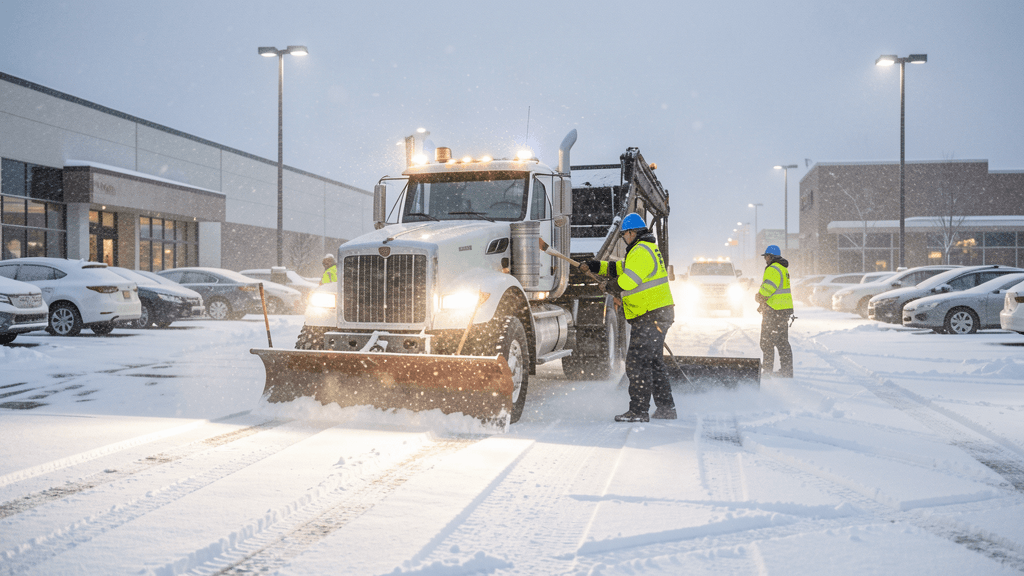
A landscaping crew in Buffalo grossed $94,000 on snow contracts last winter. A crew in the same city with the same truck, the same plow, and the same client list grossed $38,000. The difference was not effort or equipment. It was contract structure. One sold seasonal contracts with per-event triggers. The other sold per-event only and got hammered by a light winter with 11 billable events instead of the 28 they budgeted for. If you are planning your snow removal contract pricing 2026, this guide walks through the three models that separate profitable crews from break-even ones.
The contracts you sign in October determine whether your trucks run profitably in January or sit in the yard burning insurance premiums. We will break down per-event, seasonal, and hybrid pricing with real cost math so you can pick the structure that fits your client base, your risk tolerance, and your local climate.
The U.S. Bureau of Labor Statistics reports that landscaping and groundskeeping workers earn a median wage of $17.30 per hour, but snow removal work commands a premium — typically $35 to $65 per hour per worker when demand spikes during storms. Your contract pricing needs to reflect that premium, not your summer mowing rate.
How to Calculate Per-Event Snow Removal Contract Pricing 2026
Per-event pricing is the simplest model. A client pays you a fixed amount every time you show up and plow, shovel, or salt. You track visits, send an invoice at the end of the month, and the client pays for what they got.
The math starts with your fully loaded cost per dispatch. Here is a realistic breakdown for a one-truck operation servicing residential driveways in a midwestern market:
1. Truck and plow cost per hour: Your truck payment, insurance, fuel, plow depreciation, and maintenance run about $28 to $42 per operating hour. The National Oceanic and Atmospheric Administration tracks historical storm frequency data by region, which helps you estimate operating hours per season.
2. Labor cost per hour: If you are driving, your loaded labor cost (wage plus workers' comp plus payroll taxes) is $35 to $55 per hour. If you send a crew member, add their cost on top.
3. Salt and de-icer cost per visit: A typical residential driveway takes 50 to 100 pounds of rock salt at $7 to $12 per 50-pound bag. Liquid de-icer adds $3 to $8 per application.
4. Drive time: Twenty minutes each way to and from the site is unpaid time. If your billable work on-site is 30 minutes, your real cost per visit includes 70 minutes of truck and labor time.
Add it up: a residential driveway that takes 30 minutes of plowing plus 20 minutes of drive time costs you roughly $55 to $80 in truck, labor, and materials. If you charge $65 to $95 per visit, your gross margin per stop is $10 to $30. That is tight. The profitable per-event operators run dense routes — five to eight stops within a two-mile radius — so drive time drops to 5 to 8 minutes per stop and margin per hour climbs to $80 to $120.
Seasonal Snow Contracts: Hedging Against a Light Winter
Seasonal contracts flip the risk. The client pays a fixed amount upfront (or in monthly installments from November through March) for unlimited service all winter. You get predictable revenue. The client gets peace of mind. The risk is yours: if it snows 40 times, you work a lot for the same money. If it snows 8 times, you profit.
Your snow removal contract pricing 2026 strategy starts with a seasonal formula that is straightforward but requires honest local data:
Step 1: Pull the 10-year average snowfall events for your service area. NOAA's National Centers for Environmental Information provides this data free. A "snow event" is any day with accumulations of 2 inches or more — the threshold at which most clients expect you to show up.
Step 2: Multiply average events by your per-event cost (calculated above). If your area averages 22 events and your cost per residential visit is $70, your cost basis is $1,540.
Step 3: Add a risk premium. A light winter (one standard deviation below average) might produce 12 events. A heavy winter (one standard deviation above) might produce 32. Your seasonal price needs to cover the heavy scenario without losing the client on price. Most operators add 20 to 30 percent to the average-cost basis.
So: $1,540 average cost plus 25 percent risk premium = $1,925 seasonal price. Round to $1,900 or $1,950. That is your seasonal contract price for a standard residential driveway with average access and no steep grades.
When Seasonal Contracts Backfire
The seasonal model breaks down in two scenarios. First, a brutally heavy winter where you hit 35 events and your actual cost exceeds $2,400 — you lose money on every visit after event 27. Second, a client who calls you out for a 1-inch dusting because "it is slippery." You need a contract clause that defines a trigger: service is performed when accumulations reach 2 inches, not when the client feels nervous.
The Hybrid Model: Per-Event Base Plus Seasonal Minimum
The hybrid model is what the profitable Buffalo crew used. It works like this: the client pays a seasonal retainer of $400 to $600 (covering your truck availability, route planning, and salt supply), plus a per-event fee of $45 to $65 for each visit. The retainer guarantees you revenue even in a light winter. The per-event fee compensates you fairly in a heavy one.
This structure shifts risk to both parties. The client pays less in a light winter than they would under a pure seasonal contract, and you earn more in a heavy winter. The break-even point for the client is roughly 18 to 22 events — above that, a pure seasonal contract would have been cheaper for them. Below that, the hybrid saves them money.
For commercial properties (parking lots, retail centers, medical offices), the hybrid model scales up. A 30,000-square-foot parking lot might carry a $1,800 seasonal retainer plus $350 per event. The retainer covers your salt inventory, pre-storm planning, and guaranteed response time commitments. The per-event fee covers the actual plowing and salting labor.
Contract Clauses That Protect Your Margin
Regardless of which pricing model you choose, six contract clauses separate profitable snow operations from ones that bleed money all winter:
Trigger clause: Service begins when snow accumulation reaches 2 inches as measured at the nearest National Weather Service reporting station. This prevents "dusting" calls and gives you an objective standard.
Salt cap clause: Base contract includes up to 200 pounds of salt per visit. Additional salt billed at $12 per 50-pound bag. Without this, a client who wants the entire driveway salted front to back will eat your material margin.
Response time clause: You commit to service within 4 to 6 hours of trigger accumulation during business hours, and within 8 hours overnight. Do not promise "immediate response" — you cannot control weather timing or road conditions.
Seasonal definition: The snow season runs from November 15 through April 15. Events outside this window are billed separately at per-event rates. This prevents October surprises from eating into your seasonal revenue.
Payment terms: Seasonal contracts are paid 50 percent by November 1, 50 percent by January 15. Per-event contracts are billed monthly with net-15 terms. Do not let snow receivables stretch into April — you need the cash to buy salt in February.
Termination clause: Either party may terminate with 30 days written notice. Unused seasonal retainer is non-refundable after December 1. This protects you if a client tries to cancel mid-season after you have already committed truck capacity.
Pricing by Property Type: Residential vs Commercial vs HOA
Property type changes your pricing more than any other variable. Here is a practical tier structure based on real 2026 market data from contractors in the Snow Belt region:
Residential Driveways
$55 to $95 per event, or $1,200 to $2,200 seasonal. Shorter driveways (under 50 feet) sit at the low end. Steep grades, narrow access, or decorative borders that require hand-shoveling push toward the high end.
Small Commercial Properties
$200 to $400 per event, or $3,500 to $7,500 seasonal. These lots require a plow truck, not a snowblower. Factor in 45 to 90 minutes of on-site time plus salt coverage.
Large Commercial and HOA Contracts
Large commercial (20,000 to 100,000 sq ft): $500 to $1,200 per event, or $8,000 to $18,000 seasonal. These jobs often require two trucks or a truck plus a skid-steer. Salt usage jumps to 500 to 1,500 pounds per event. HOA and multi-unit residential: $3 to $6 per linear foot of road frontage per event, or $8,000 to $25,000 seasonal. HOA contracts are attractive because the route density is high — you plow a connected network of roads and driveways without driving between sites. But HOA boards negotiate hard and often demand 90-day payment terms, which strains your cash flow in January and February.
When to Walk Away From a Snow Contract
Not every snow contract is worth signing. Three red flags should make you reconsider:
Unrealistic trigger expectations: If a commercial client wants service triggered at 1 inch of accumulation, your visit count could double. A 1-inch trigger in Buffalo means 45 to 55 events per season. Price accordingly or walk.
Open-ended salt requests: "Just salt everything" with no cap is a margin killer. A 20,000-square-foot lot fully salted at 3 pounds per 1,000 square feet uses 60 pounds. The same lot "heavily salted" at 8 pounds per 1,000 uses 160 pounds — and the client will not notice the difference. Cap it in writing.
Payment terms beyond net-30: Snow work is cash-intensive. You buy salt in November, pay labor weekly in January, and fuel the truck every three days. If a client wants net-60 or net-90, you are financing their snow removal. Either charge 10 to 15 percent more for the extended terms or require a seasonal contract with upfront payment.
Building Your 2026 Snow Contract Strategy: A 6-Month Review
The contractors who make real money on snow do not wing it in October. They start in August. Here is a practical timeline:
August: Pull NOAA historical data for your service area. Calculate your 10-year average event count and standard deviation. Set your per-event cost basis using current fuel, labor, and salt prices.
September: Contact last year's clients with renewal offers. Adjust pricing based on last year's actual events versus your forecast. If you ran 28 events on a 22-event seasonal contract, raise the price 15 to 20 percent or switch to hybrid.
October: Sign new clients. Lock in seasonal retainers. Order salt — bulk pricing in October is 20 to 30 percent cheaper than in January when everyone is scrambling.
November through March: Execute. Track every event, every cost, every hour. The data you collect this winter determines your pricing power next September.
April: Reconcile. Compare actual events to forecast. Calculate real margin per client. Identify which contracts lost money and which overperformed. This is the data that lets you confidently raise prices or restructure terms for the 2027 season.
The difference between the $94,000 crew and the $38,000 crew was not luck. It was contract structure, route density, and the discipline to track what actually happened versus what was forecast. Pick your model, price it honestly, and let the data tell you what to change next year.
This guide is published by Heyfield, which makes an AI phone receptionist for home-service trade businesses. If you ever can't take the call, that's what we do. See pricing. The rest of our trade-business resources are free at heyfield.app/blog.
Frequently Asked Questions
How much should I charge per snow removal visit in 2026?+
Residential driveways typically run $55 to $95 per visit. Small commercial lots range from $200 to $400. Your price should cover truck cost ($28-$42/hr), labor ($35-$55/hr), salt ($7-$12 per 50 lb bag), and drive time — not just on-site minutes.
Is a seasonal snow contract or per-event pricing better for a 2-truck crew?+
Seasonal contracts give you predictable revenue but cap your upside in heavy winters. Per-event pricing pays you for every visit but risks a light winter. The hybrid model (seasonal retainer plus per-event fee) balances both and is what most profitable crews use.
What is a snow trigger clause and why does it matter?+
A trigger clause defines when service begins — typically when snow accumulation reaches 2 inches at the nearest National Weather Service reporting station. Without it, clients will call you out for dustings, doubling your visit count and halving your margin.
How do I price a commercial parking lot for snow removal?+
Small commercial lots (under 20,000 sq ft) run $200-$400 per event or $3,500-$7,500 seasonal. Large lots (20,000-100,000 sq ft) run $500-$1,200 per event or $8,000-$18,000 seasonal. Factor in 45-90 minutes of on-site time and 500-1,500 pounds of salt per visit.
When should I walk away from a snow removal contract?+
Walk if the client wants a 1-inch trigger (your visit count doubles), demands open-ended salting with no cap, or requests payment terms beyond net-30. Each of these destroys your margin or strains your cash flow during the most cash-intensive months of the year.
How do I calculate my cost basis for snow removal?+
Add your truck and plow cost per hour ($28-$42), loaded labor cost ($35-$55/hr), salt per visit ($7-$15), and drive time. A residential driveway with 30 minutes of plowing and 20 minutes of drive time costs $55-$80 fully loaded. Price above that to earn a margin.
Should I buy salt in October or January?+
Buy in October. Bulk salt pricing in October is 20 to 30 percent cheaper than January, when demand spikes and suppliers raise prices. Storing 5-10 tons in October locks in your material cost before the season starts.
What payment terms should I use for seasonal snow contracts?+
Charge 50 percent by November 1 and 50 percent by January 15. This front-loads your cash flow when you need it most — buying salt, paying weekly labor, and fueling trucks. Avoid net-60 or net-90 terms, which force you to finance the client's snow removal through February.
Ready to stop missing calls?
Try Heyfield free for 7 days. Your AI receptionist answers every call, collects customer details, and texts you the summary.
Keep Reading
Why Welding Shops Can't Risk Answering Their Own Phones
Sparks fly, face shields go down, and phone calls go to voicemail. How safety-first welding shops lose business to missed calls.
ReadPool Service Owners: Every Missed Call Costs You $900
Pool season is short and winterization is now. One missed call can cost you a full-season client worth $900+. Here's how solo pool service pros stop losing jobs to voicemail.
Read